
Article by Watts Up With That
UAH Global Temperature Report: July 2015 – the pause continues
Anthony Watts / 25 mins ago August 13, 2015
Global climate trend since Nov. 16, 1978: +0.11 C per decade
July temperatures (preliminary)
Global composite temp.: +0.18 C (about 0.32 degrees Fahrenheit) above 30-year average for July.


Northern Hemisphere: +0.33 C (about 0.60 degrees Fahrenheit) above 30-year average for July.
Southern Hemisphere: +0.03 C (about 0.05 degrees Fahrenheit) above 30-year average for July.
Tropics: +0.48 C (about 0.86 degrees Fahrenheit) above 30-year average for July.
June temperatures (revised):
Global Composite: +0.33 C above 30-year average
Northern Hemisphere: +0.41 C above 30-year average
Southern Hemisphere: +0.25 C below 30-year average
Tropics: +0.46 C above 30-year average
(All temperature anomalies are based on a 30-year average (1981-2010) for
the month reported.)
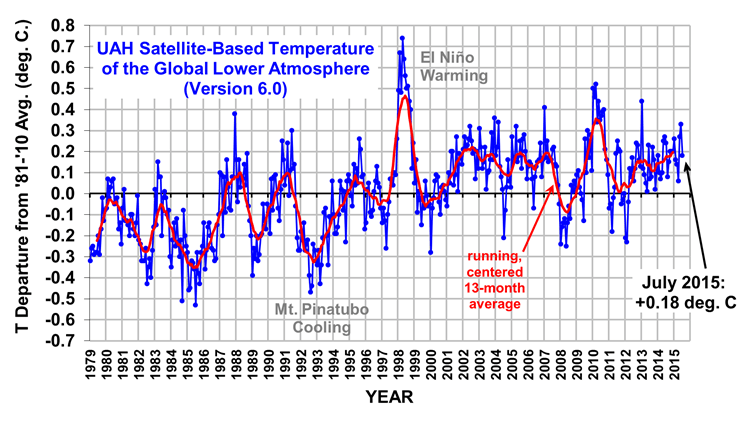
The Version 6.0 global average lower tropospheric temperature (LT) anomaly for July, 2015 is +0.18 deg. C, down considerably from the June, 2015 value of +0.33 deg. C (click for full size version):
The global, hemispheric, and tropical LT anomalies from the 30-year (1981-2010) average for the last 7 months are:
YR MO GLOBE NH SH TROPICS
2015 1 +0.28 +0.40 +0.16 +0.13
2015 2 +0.18 +0.30 +0.05 -0.06
2015 3 +0.17 +0.26 +0.07 +0.05
2015 4 +0.09 +0.18 -0.01 +0.10
2015 5 +0.29 +0.36 +0.21 +0.28
2015 6 +0.33 +0.41 +0.25 +0.46
2015 7 +0.18 +0.33 +0.03 +0.48
Strong July cooling occurred in the Southern Hemisphere extratropics, with a weak drop in the Northern Hemisphere extratropics. The tropics continue to warm with El Nino conditions there.
The global image for July, 2015 should be available in the next several dayshere.
The new Version 6 files (use the ones labeled “beta2″) should be updated soon, and are located here:
Lower Troposphere: http://vortex.nsstc.uah.edu/data/msu/v6.0beta/tlt
Mid-Troposphere: http://vortex.nsstc.uah.edu/data/msu/v6.0beta/tmt
Tropopause: http://vortex.nsstc.uah.edu/data/msu/v6.0beta/ttp
Lower Stratosphere: http://vortex.nsstc.uah.edu/data/msu/v6.0beta/tls
Notes on data released Aug. 12, 2015:
The tropics continued to warm in July, although the areas between the tropics and both the Arctic and Antarctic regions cooled from June, said Dr. John Christy, director of the Earth System Science Center at The University of Alabama in Huntsville.
Compared to seasonal norms, the warmest average temperature anomaly on Earth in July was in southeastern Kazakhstan near the city of Almaty. The July temperature there averaged 3.33 C (about 6.0 degrees F) warmer than seasonal norms. Compared to seasonal norms, the coolest average temperature on Earth in July was in the northern Atlantic Ocean off the southeastern coast of Greenland, where the average July 2015 temperature was 3.77 C (about 6.77 degrees F) cooler than normal.
The complete version 6 beta lower troposphere dataset is available here:
http://vortex.nsstc.uah.edu/data/msu/v6.0beta/tlt/uahncdc_lt_6.0beta2
Archived color maps of local temperature anomalies are available on-line at:
http://nsstc.uah.edu/climate/
As part of an ongoing joint project between UAHuntsville, NOAA and NASA, Christy and Dr. Roy Spencer, an ESSC principal scientist, use data gathered by advanced microwave sounding units on NOAA and NASA satellites to get accurate temperature readings for almost all regions of the Earth. This includes remote desert, ocean and rain forest areas where reliable
climate data are not otherwise available. The satellite-based instruments measure the temperature of the atmosphere from the surface up to an altitude of about eight kilometers above sea
level. Once the monthly temperature data is collected and processed, it is placed in a “public” computer file for immediate access by atmospheric
scientists in the U.S. and abroad.
Neither Christy nor Spencer receives any research support or funding from oil, coal or industrial companies or organizations, or from any private or special interest groups. All of their climate research funding comes from federal and state grants or contracts.
— 30 —


Recent Comments