

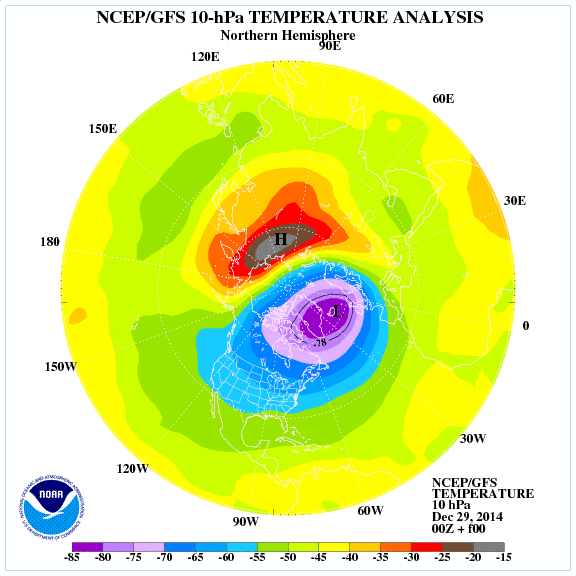
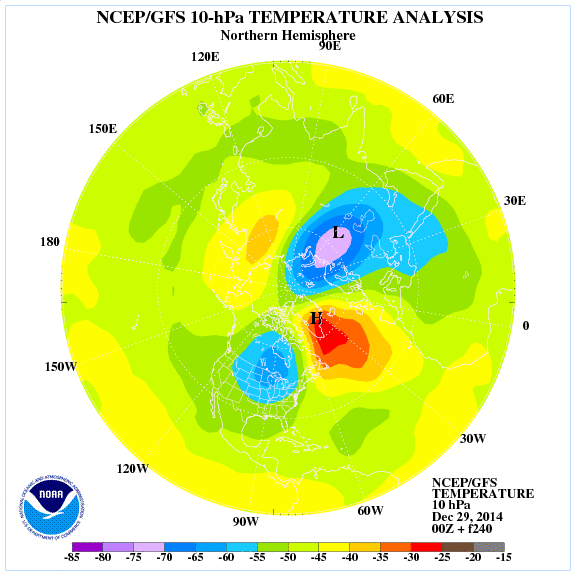
The latest GFS 10mb temperature profile suggests a major event is ready to occur. By that I mean a sudden stratospheric warming as the model shows a complete 180 degree flip in the temperature profile over Greenland.
The model takes apart the strong cold pool and develops a major warm pool where the core of the cold was within 10 days. This suggests an SSWE and PV split with one piece diving into eastern North America, the other into Eurasia.
With the positioning of the warm pools over Alaska and particularly Greenland, you have to assume that the arctic air will dive into the eastern United States in wave fashion similar to last year.
Check this out.
Initial
[s2If current_user_can(access_s2member_level1)]
10 days from now.
In a post by Joe D’Aleo of Weatherbell, the ECMWF warms the polar stratosphere 80C within 10 days from -91 to -11!
The implications of the above strat warming would probably be felt fully LATER January despite the chill of the next 10 days. There may be some pullback of the cold mid month before a new surge of arctic air comes down in response to the projected SSWE.
The strength of the surface high currently diving into Montana is also rather interesting. How rare is it to see a 1058 to 1060 high? According to Ryan Maue of WeatherBell, the last time it occurred was 1989, before that 1983. Both those years saw super cold outbreaks and SSWE’s. Hope I’m not jumping the gun but there’s a lot pushing towards another major or even super cold outbreak this year despite this very mild December.

ECMWF snow forecast through 48 hours focuses on the SOUTHWEST including the Las Vegas Valley.

Credit: AccuWeather Pro
ECMWF snow projections over the next week.

Credit: AccuWeather Pro
10 days

Credit: AccuWeather Pro
ECMWF shows focus of cold in the West next 5 days with impressive 5-day mean departures of 15-25 below normal.

Credit: AccuWeather Pro
The above 10mb temp charts suggests that the current arctic blast with rare near 1060mb high is one of SEVERAL waves of cold that will dive into the Lower 48 in January and probably February.
CFSv2 shows colder than normal over the East with warmth in the West and up into Alaska both January and February.


[/s2If][s2If current_user_cannot(access_s2member_level1)][magicactionbox id=”18716″][/s2If]


Recent Comments