
>
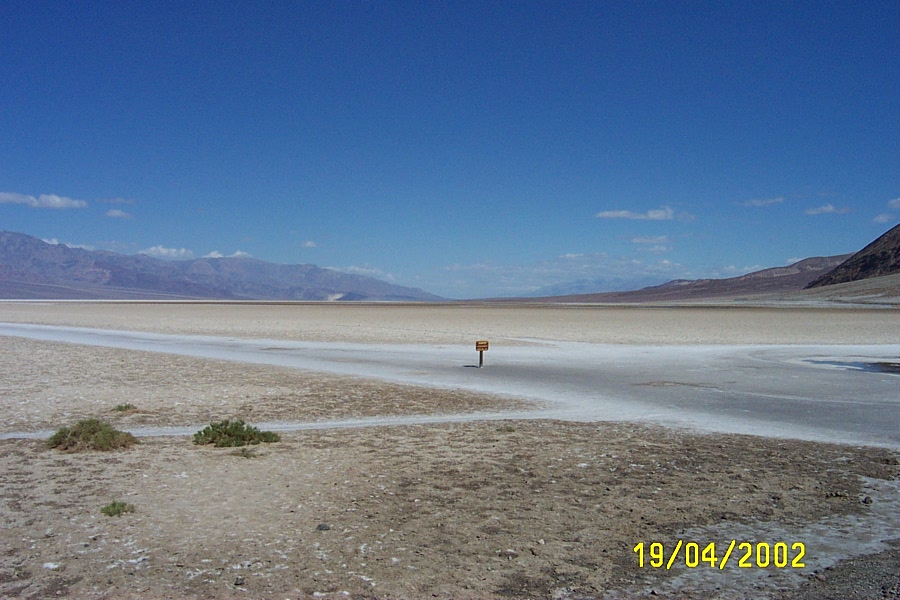
 Badwater (Death Valley)
I have long been drawn by the numbers Death Valley can condure up during the long hot summer months. It’s simply astonishing when you see Phoenix or Las Vegas pull off numbers of 118 or 117 and places like Laughlin only the shore of the Colorado River that can top 125. It makes even the steam bath places of Houston, New Orleans or Miami look wimpy even when you add their clingy 80 degree dew points in 95-degree air..
I don’t care what anyone says, but even Palm Springs on a “normal” summers day at 108 degrees under unlimited sunshine that makes you feel as though your getting jack hammered into the scalding asphalt by a sun that you’d think couldn’t produce temperatures any warmer, so it gets hotter and hotter and hotter until you get to July 2006 when the thermometer tops off an amazing 121 degrees which breaks the July record. Hottest ever? Oh no… the hottest is 123!! What an earth does that feel like? Amazingly whilst high pressure is strong here 5-6 months of the year and moderate during the short winter months, the only difference is summer pressures are stronger, the high is parked there year round, bar 2-3 low pressure passings which bring cloud and rain. But even in winter a moderated form of the same high that sweats the Desert Southwest is the dominant weather feauture here when the rest of the country is fighting wind chills and snow.
The subtropical high stretches across the southern tier bringing the hot weather to the Deep South, only difference is the circulation rotates tropical humidity and moisture into the equations bringing a much more tropical summer pattern filled with high heat indexes and frequent thunderstorm days. The Desert Southwest usually recieves a flow of air off the Mexican desert, so the air is generally hot and very dry.
Why so hot? The face of the desert floor reacts to the atmosphere, lack of vagatation means there is little to no moisturethat can be added to the air, therefore the subsiding air heats the ground and then heats the atmosphere bottom-up, no moisture means the sun’s ebergy goes 100% into heating rather than evaporation which occurs literally as as you go east of the Rockies. The desert-atmosphere connection “pump” the Four Corners High, when it starts rising towards the 590-600 decamteres, that means that there is maximum depth within the roof and bottom of the atmosphere is which “air” can drop, sink, subside from. Because of the varying elevations of the desert Southwest, certain areas that are lower elevated will recieve hotter surface temperatures. That’s why many flock to mountain retreats if they either hate the heat or wish to escape it for a bit. After all, it must get tiring under brutalising sun and 105 degrees every day…
Other factors as well as elevation come into play when it comes to heat. Position of the High Pressure “core” can be extremely important as the strongest heights within the atmosphere boast where the worst of the heat wave will occur. The mean position of this 1-2 heat core (1 four corners other a continuation of the Bermuda high) is centered over the Fours Region, hence the name, but this system is not static, it moves, it flexes or pulses and often it’s effected by surrounding weather systems. Quite often the semi-permanent Aleutian low will spin systems towards the Southwest US, these never push off the high but can dent it, weakening it, make it slide east or west and also can strengthen it. If this high is strong but centered over New Mexico, it can pull moisture up from the Gulf of California and bring chances of thunderstorms when moisture levels are raised, use the hot air and bang, you get storms blow up, particularly over the mountainous area where convective columns are more vigorous.
However, pump up the ridge and sit it right over southern Nevada and you can get a set up like 2005 where Las Vegas endured a guelling heat wave which spiked peak temperatures to 117 degrees, it also brought record heat throughout the desert. Palm Springs 120, Indio 122, Phoenix 115 (lower because pressures weren’t as high over Arizona) but Death Valley because of it’s close proximity to maximum heights soared to a stunning 129 degrees, nighttime lows on at least 2 nights failed to get below 100 degrees.
Because the high was more inland, coastal areas of California missed out of the brutal heat and a stronger marine influence was found. The mountains surrounding LA and along the coast, blocked the worst heat and therefore LA may have only seen 80s, beaches 70s whilst 120 degrees was getting hit just over 100 miles away from the beaches… Fog and cloud can remain along the coast and bring dreary, gloomy and surprisingly chilly days.
However, when you slide the high west, baring in mind, heights need to be very strong to support the maximum subsidence, sinking and compressional warming, you can bring intense heat to both desert and coastal communities just like see witnessed in 2006 when Downtown LA topped 101 degrees, 114 in Riverside, 121 in Palm Springs, 128 in Death Valley, 116 in Las Vegas and 118 in Phoenix…
Not only can you see heat waves in certain areas and not other, but things can also be altered if the pressure gradient within the vertical profile of the atmosphere isn’t so steep. For example, if the 590dc height was spread over 1,000 miles compared to 500 miles because there wasn’t the same type of inhibiting weather systems surrounding, then you’d get a widespread heat wave like in 2006 when 118 was achieved in Phoenix, Seattle topped 98 because the field of heights was much greater in area than normal… We can get the opposite when a very small area of extreme heat is found. I even use this heat event that’s occured right now over the Southwest.
Downtown LA got to 87, whilst 118 was reached in Palm Springs, Las Vegas got no better than 113, Phoenix 114 but Death Valley topped 128! My point being, that the pressure gradient and position of the systems wind flow made areas that you would have thought would get brutal heat, didn’t. Stronger pressures over a much greater area made for the 2006 scenario to produce record heat from Downtown LA to Nevada. The maximum height of 599dc may have spread from Baker, CA to southern Utah rather than an area covering just a few hundred miles. Despite 101 in Downtown LA we can still remarkably see a knife edge divide in temp right on the coast where onshore winds blow, conteracting with the intense land heating which vigorously rises and is replaced by the cooler ocean air. 80 on the beach to 100, miles a couple of miles inland can be witnessed. The marine layer itself with it’s cloud and fog often are pushed well offshore when high pressure systems move west from it’s desert origin, meaning unlimited sunshine from sunrise to sunset (but winds will kick in with land heating nontheless)
Now it’s understandable why areas of the deserts get hotter than other surrounding areas, could be 1) elevation 2) exposed to a gap somewhere that allows marine air in 3) areas that are low and in a basin or sheltered valley can markedly heat further than somewhere only a mile away. local effect and the micro climates of California make this a unique place.
Death Valley: Why does this seperate itself from the rest of the “hot spots”
If you were to ask me (someone who has been facinated and deeply studied the climate of California for over 8 years) where are the “Hot Spots” of California. Id say Redding, Red Bluff (the surprising, northern Sacramento valley location which gets some fierce heat when they recieve downsloping winds from the north and can witness afternoons that get to 115 and greater, 117 was recorded at Redding in June 2006. Palm Springs, well inland and sheltered by surrounding mountain of 12,000 foot high, low in elevation and desert landscape is perfect for extreme heat. Baker. Located technically within the “high” desert, Mojave Desert” but is low in elevation and within a valley or basin which can heat to greater levels than most other valley/basin areas across the state. July 2007 saw a 125-degree afternoon at the remote outpost of Baker, used mainly as a rest stop between LA and Vegas. The area of the southern end of the Coachella Valley which slopes to sea level and slightly below (not far south of Palm Springs) down by the Salton Sea can experience 124 degree afternoons and the abandoned town of Salton has hit 129. Amos in the Salton basin has hit 130 degrees in the past.
Then there’s Death Valley at the southern edge of the Sierra Nevada range is surrounded by the lower 48’s tallest peaks and is a long, deep valley. The sheer height of these mountains create a near perfect rain shadow, allowing for years with no measurable rainfall. Depth of the valley which ascends down the walls of 14,000ft ridges and down beyond sea level to a depth of 282 feet below sea level. Making this the Western Hemisphere’s lowest point. Depth of the valley and sparse vegatation allow maximum sunshine to heat the valley floor.
The extreme dryness of the air heats the surface and this heat built up at the surface is radiated back off the soil and rocks and rises, cools slightly but is trapped by the tall valley walls and is recycled back down to the surface. These pockets of rediscending air is only slightly cooler than surrounding air and is compressed ad heated further due to low elevation air pressure. These superheated air parcels move across the valley floor and support temperatures far higher than surrounding valleys and basins because of unique geography and low elevation. So that is why when it’s 115 in Phoenix, be grateful your not in Death Valley where highs every summer top 125 and can rise to a noise hair away from 130 degrees…. Temperature can and do recieve lows at or above 100. I remember seeing days of 128-129 and still 120 at 10pm at night, 110 at 3am, 105 at 5am and 103 at 7am and that as the morning “low”. Yes in 2003 after a daytime high of 128 degrees, the morning low was 103 degrees which was a tie for hottest night anywhere in North America on record. In 2007 it was said that a low of 100 was recorded at Thermal near the Arizona border, only place outside of Death Valley to achieve this. Would you want to achieve that? No nighttime relief that’s for sure. Apparently in 2003 Death Valley had two consecutive nights of 100. 102 and 103 was the low.The first 103-degree low was 1970.
Other areas can and do see hot nights but not quite as bad as Thermal or Death Valley. In fact in 2003 Phoenix hit a low of 96. In 2005 Las Vegas hit new hot low of 93 and two nights later broke that new all-time low by hitting a new one of 95. I put some of this remarkable increase in record high lows down to rapid urban expansion, adding so much more concrete and asphalt means greater daytime absorption of heat and release into the air at night. Therefore setting the base for even higher daytime highs as the air is starting the heating prcess at sunrise warmer than normal because of warmer nights helped by man-made surfaces. Other night hot spots are desert locales such as Palm Springs, Laughlin, basically the hot spots. But some areas like the high desert and with higher elevation, changes in soil compostion are found and therefore greater or lesser heat retainment. Some places like Palm Springs will see nights remain in the 90s, others struggle to stay in the 70s..
I hope to talk more about heat history of the deserts of the southwest in future posts.
Thanks for reading.
– Mark


>Thats the sh**, to know about hot wheathers! I got so amazed by Death Valley! Im going to visit one time this month or in august. Is death valley technicly the hottest place on earth? If you have an answer for me, Email me at [email protected] bye!